In a micro business, IT support is often one person: a local IT company, a freelancer, or a friend who's good with computers. Whoever it is, they probably have your passwords and admin access to your email, files and website. The NCSC's guidance on choosing a managed service provider is written for small organisations, sole traders and the self-employed too, and the questions are worth asking whoever looks after your IT.
What the NCSC guidance says
In November 2025 the National Cyber Security Centre (NCSC) published Choosing a managed service provider (MSP), a short guide for small and medium-sized organisations, sole traders and the self-employed (also available as a PDF). Its message is simple: an MSP has access to your systems and data, so check how seriously it takes cyber security before you sign, and write what you agree into the contract.
The guidance covers four areas:
- Choosing the MSP: recognised certification, references from similar organisations, and open, clear communication.
- Security services: prompt security updates (critical and high-risk ones within 14 days), tested backups, 2-step verification, least-privilege access, logging and a clear incident response process.
- The contract: a responsibilities matrix, response and resolution times, how and when you're told about incidents, regular reporting, liability, and how renewal and exit work.
- End-of-life systems: who tracks when your hardware and software stop getting security updates, and acts before they do.
Start with certification: ask for Cyber Essentials
The NCSC's first check is whether the MSP holds a recognised certification. Its guidance gives Cyber Essentials Plus as its example, alongside ISO 27001 and SOC 2. For most small organisations, the practical place to start is Cyber Essentials itself: the UK government-backed scheme showing that an organisation has the five technical controls in place that protect against the most common cyber attacks. Cyber Essentials is a verified self-assessment; Cyber Essentials Plus covers the same controls and adds a hands-on technical audit. IASME, the NCSC's Cyber Essentials delivery partner, also highly recommends choosing an IT provider that is Cyber Essentials certified.
Asking your MSP for Cyber Essentials does three useful things:
- It's quick to check. Ask for the certificate number and the legal name it's issued to, then confirm it on the official NCSC certificate search using our free certificate search tool.
- It shows how they run their own business. An MSP that keeps its own devices updated, protects its admin accounts with multi-factor authentication and controls who has access is far more likely to do the same for you.
- It helps with your own Cyber Essentials. Your MSP is a contractor. Under the NCSC's Requirements for IT Infrastructure v3.3, its own devices are outside your scope, but you're still responsible for confirming they're configured correctly. The MSP holding its own Cyber Essentials certificate is one of the three ways IASME's guide to working with contractors describes (Option A). The accounts your MSP uses in your systems are always in your scope and need multi-factor authentication.
A certificate shows the MSP met the requirements when it was assessed, and it's renewed every 12 months. Check the dates, check it covers the part of the business that will support you, and ask the MSP to tell you if it lapses. Our guide on how to check a Cyber Essentials certificate explains what to look for.
The questions to ask
Beyond certification, the NCSC's checklist comes down to a handful of questions. Ask them of any MSP you're considering, and of your current one when the contract comes up for renewal:
- How quickly do you install critical and high-risk security updates, and on which systems?
- What do you back up, where is it kept, who can access it, and how often do you test a restore?
- Does every one of your staff use their own named account with 2-step verification when they access our systems?
- How would you tell us about an incident, how quickly, and what happens if you're the one that's compromised?
- What response and resolution times does your SLA give us, and what costs extra?
- Who tracks when our hardware and software reach end of life?
- If we leave, how do we get our data, admin accounts and documentation back, and how is your access removed?
Keep it proportionate: five questions that matter most
The full questionnaire below may be more than you need for a few laptops and an email account. If so, start with these five:
- Do you hold Cyber Essentials? If so, what's the certificate number?
- When you work on our systems, will you use your own named login with 2-step verification, not ours?
- How quickly will security updates be installed on our devices?
- What's backed up, where, and have you tested getting it back?
- If we stop working together, how do we get all our passwords, admin access and data back?
And one for you: make sure your domain name, email account and website hosting are registered to your business, with an admin login you hold yourself. It's the single most useful protection if your IT person moves on.
A freelancer or one-person IT business may not hold Cyber Essentials. That's common, and IASME's contractor guidance describes other ways to cover them if you're getting certified yourself, such as bringing their device into your scope or giving them access only from a device you manage.
Download the questionnaire and email template
We've turned the NCSC's checklist into a questionnaire you can send to any MSP you're considering. It's a fillable PDF, so the MSP can type its answers straight in and send it back, and it's free to use and share.
Download the MSP security questionnaire (PDF)
Copy this email, fill in the parts in square brackets and attach the questionnaire:
Subject: A few questions about our IT support
Hi [name],
Thank you for [your proposal / supporting our IT]. Before we [make a decision / renew our agreement], we're following the National Cyber Security Centre's guidance on choosing a managed service provider (MSP): https://www.ncsc.gov.uk/guidance/choosing-a-managed-service-provider-msp
We're a small business, so we know some of the questions may be more than we need: please just answer what applies.
Could you please complete the attached questionnaire and return it by [date]? In particular, please let us know whether you hold a current Cyber Essentials or Cyber Essentials Plus certificate, with the certificate number and the legal name it's issued to, so we can check it on the official NCSC certificate search.
If any question doesn't apply to the service you'd provide, just say so. We're happy to talk any of it through.
Kind regards,
[Your name]
[Your role]
[Organisation]
What if your MSP isn't certified?
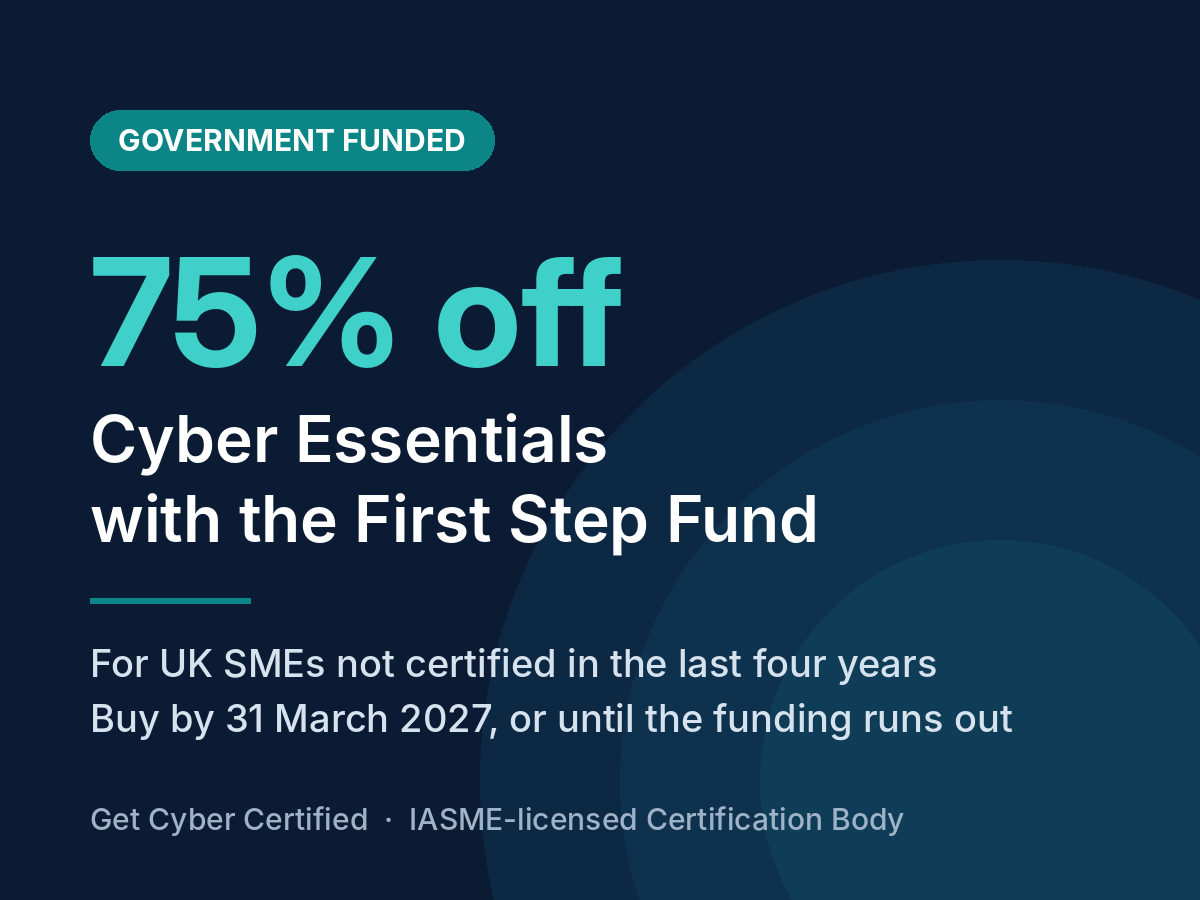
It isn't automatically a reason to rule them out, but ask when they plan to be, and look harder at their other answers. If they're not certified yet, we certify IT providers too: see our IT partners page. An MSP with fewer than 250 employees that hasn't held Cyber Essentials in the last four years may qualify for 75% off through the government's First Step Fund.
As a certification body we stay impartial: we don't recommend or endorse any MSP or product. Our job is to check that the Cyber Essentials requirements are met.
Getting certified yourself?
The government's Cyber Essentials First Step Fund takes 75% off a new Cyber Essentials assessment for UK organisations with fewer than 250 employees that haven't held Cyber Essentials in the last four years. The government says you could pay as little as £80 and no more than £125 plus VAT. Buy before 31 March 2027, or before the funding runs out.
The First Step Fund covers a self-assessment that we mark, without assessor support. If you'd like an assessor with you all the way, you can add our Supported Certification add-on before marking starts, from £400 + VAT.
Apply for First Step through us · Cyber Essentials for micro organisations
Sources
- Choosing a managed service provider (MSP), NCSC, version 1.0, 24 November 2025 (PDF)
- Cyber Essentials: Requirements for IT Infrastructure v3.3, NCSC
- The Cyber Essentials guide to working with contractors, IASME
- NCSC certificate search, IASME
This article refers to the NCSC’s Requirements for IT Infrastructure v3.3. Find it on our members’ page, next to the Danzell question set, with links to the matching Resource Hub articles.
Cyber Essentials certificate search: Check whether a company holds a current Cyber Essentials or Cyber Essentials Plus certificate using the official NCSC certificate search.
Prefer an assessor to take you through it? See Supported Certification.
Is anything in this article incorrect or out of date?
Microsoft, Google and other vendors change their screens regularly. If you’ve spotted an error or if something no longer matches what you see, tell us here. Every report is reviewed, and we credit contributors (with your permission).